Sure, lots of people talk about budgeting on the internet. You could look up a YouTube video of someone going over their budget, but many of those people aren’t average Joes. When I looked up budgeting videos, I found millionaire after millionaire: content creators who profit from their financial knowledge.
Here’s a little about my background for transparency’s sake. I’m not a financial expert, but a lower middle-class individual. I work in public K-12 education, where I make just over $50,000 a year. Living in a small city, I share an apartment with my partner. My partner and I have separate bank accounts for our individual expenses and a shared bank account for shared expenses. My mom helps with my student loans, but currently she’s paying less than $150 a month. As someone who is often guilty of emotional, impulsive spending, I struggle to stick to my budget.
I have spoken to a financial advisor (provided through my work) and my retired friend about how to budget and have been using this method successfully for a few months now. This is not the end-all, be-all of budgeting. I am simply showing you what I do, hoping to inspire your budgeting.
Things I’ve Tried That Didn’t Work for Me
I have been trying to be responsible with my money since I was eighteen and got my first credit card. Over the years, I have tried many apps, but I’ve found that what works for me is a good old laptop and spreadsheet. Here are the apps I have tried:
- YNAB
- Monarch Money
- Rocket Money
- GoodBudget
- Notion (side note: I used to love Notion for all sorts of work, but they’ve gone downhill with all their AI-pushing.)
- Annual budget-tracking spreadsheets
If you absolutely need an app, I recommend YNAB (not sponsored). It’s $15 per month, but their zero-based “give every dollar a job” approach works really well, and I have continued to use this method in my spreadsheets.
I don’t think an app is necessary for budgeting. Yes, it’s convenient to see how much you have available to spend at any moment. However, I see a budget as nothing but a plan. After you budget, you need to build the skills to overspend less often and to track your spending. These are separate tasks. Let’s go through them.
Your Reason Why
An old friend I had was always adamant about having “your reason why,” as she called it. I try to remember her guidance whenever I am struggling with life. With budgeting, your reason why can include your long-term goals, short-term plans, and the people you have to support. Finding very specific numbers for what your dream life will cost is a great way to motivate yourself. If you’re interested, here is mine. If not, skip ahead.
My Reason Why
I would someday like to move to Long Beach, California. I looked up a few jobs there similar to what I work right now, and they pay around $65,000 there. Sounds great! Let’s figure out how much it costs to live there.
I would like to have a 3-bedroom apartment, which can be close to $3,000 per month. Let’s throw in $100 for pet rent for two cats. I’ll also need to have $3,000 saved for a security deposit. The apartment is a shared expense with my partner, so I’ll cut it in half.
A new car would be nice. We’ll budget for a $500 car payment. Maybe $750 if I include car insurance. $700 for groceries and restaurants. I’ll have to save for retirement and take taxes out.
Considering all my general life expenses and these goals, I’ll have enough to live on and to save about $400 per month (excluding retirement accounts). This can only happen if I pay off all my debt, which will take 8 years if I pay minimum payments, and 5 if I pay an extra $150 per month.
So, my reason why is that in order to have my dream life, I need to pay off my debt. It’s something that I believe will make me truly happy, but I need to do the work of budgeting and tracking my money to get there.
Budgeting
I budget before the month starts. If you get paid on the last day of the month and use that money for the following month, I would budget before you get paid. This is just a plan for how you want to spend your money this month.
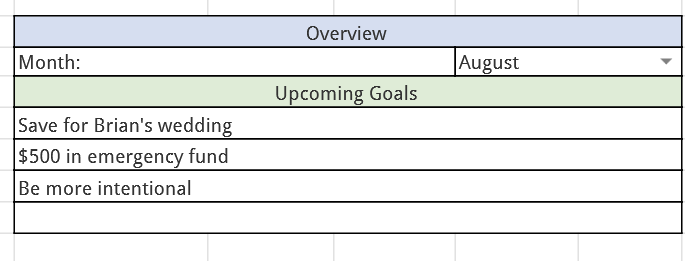
The above image is the first section of my budget. It’s important to me to remind myself of my goals first. This way, I can approach my money with my reasons for budgeting in mind.
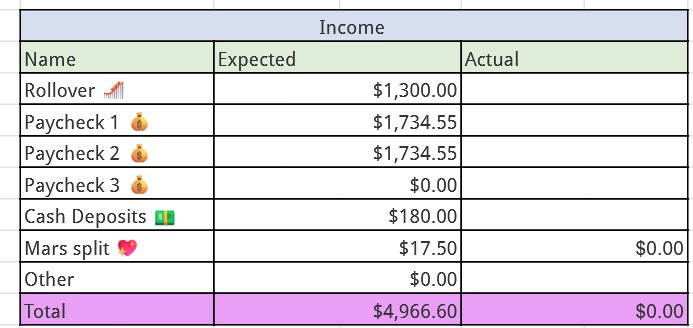
The next section I fill out is my income. I have a salary, so my paychecks are exactly the same every time I get paid, which is twice per month. If I had an hourly job, I would do the math (here is a calculator I like) on how many hours I’m expecting to work in the following month. Also, make sure you plan for the worst plausible scenario. This doesn’t mean you should assume your hours at work will get cut, but calculate on the low end of what you might get paid.
“Rollover” is the amount I have left in my checking account at the beginning of the month. I have another section to ensure I have enough here. “Cash deposits” come from my second job where I work on some weekends, and I get paid in cash. “Mars split” is the amount of money my partner pays me for certain things. Like I said, we have a shared bank account, but if I buy something unnecessary and they pay me back, that’s where it would go.
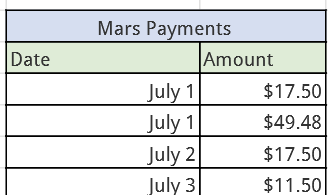
Here is an example from July. The actual amount for “Mars split” sums from this table, so I don’t have to do any math.
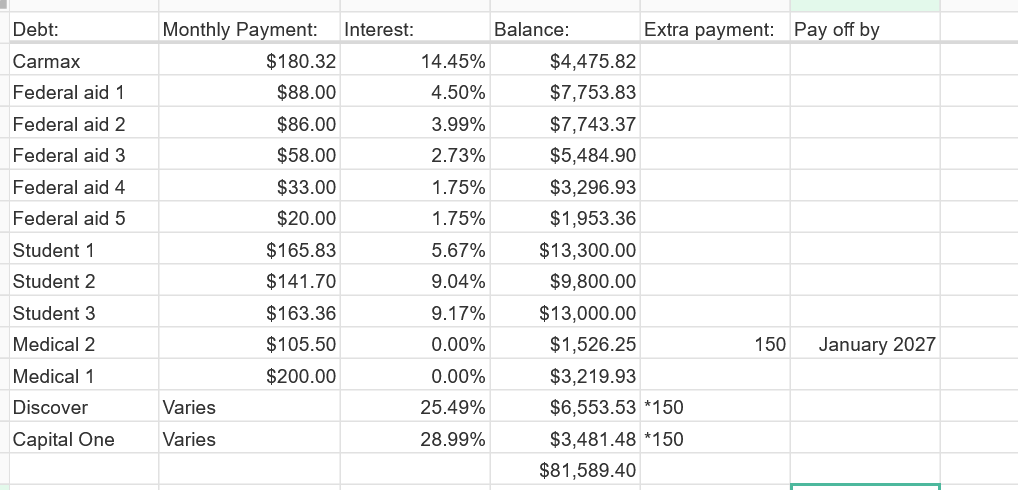
Before I go into my bills, I have to figure out how much I want to spend on paying off my debt. I have a separate tab on my spreadsheet for this. I use this loan calculator to figure out how quickly I can pay off a specific loan. My preferred strategy for loan repayment is the snowball method. This means paying off the lowest balance first, which I like because celebrating small wins more often helps with motivation.
Another option (and probably the smarter option) is the debt avalanche method, which means paying off the high-interest loans first. If you choose to do that, it will take longer to pay off your first loan, but you will pay less overall and may pay off everything faster.
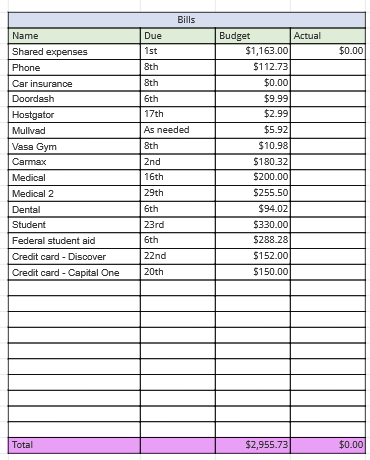
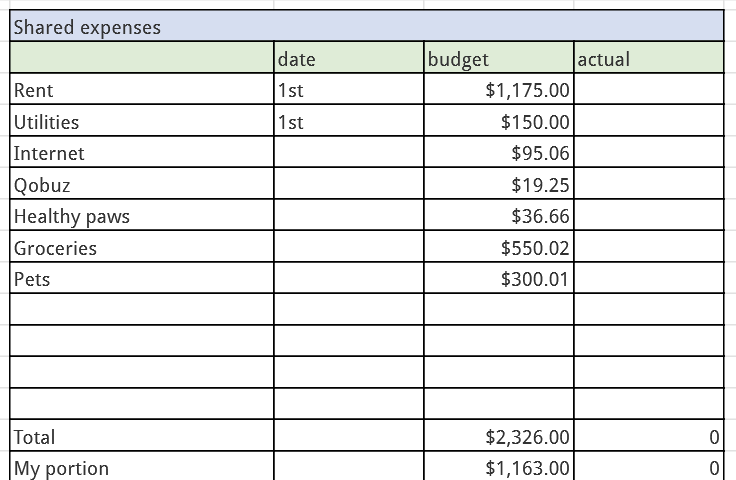
Here is my “Bills” table, which is really just all my fixed expenses. “Shared expenses” is the amount that goes into my shared checking account with my partner, which comes from the smaller table.
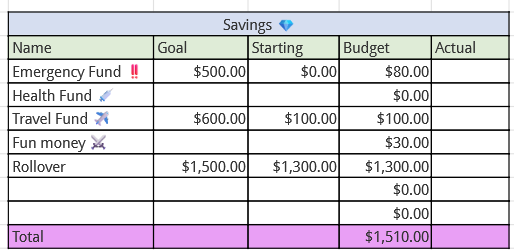
Next is my “Savings” table, which shows my different savings goals, the amount I currently have, and how much I plan to transfer to my savings account. You will also see “Rollover” again. I have been working in the past few months to get this high enough to afford rent if something should happen, which is also why my other goals are so low.
I prefer to put money into my savings before putting money into variable expenses. Savings isn’t just money you can’t use, but it’s money you are giving your future self. Saving money for your future self is literally putting yourself first and is exciting! You’re getting closer to your long-term goals by putting money into your savings account.
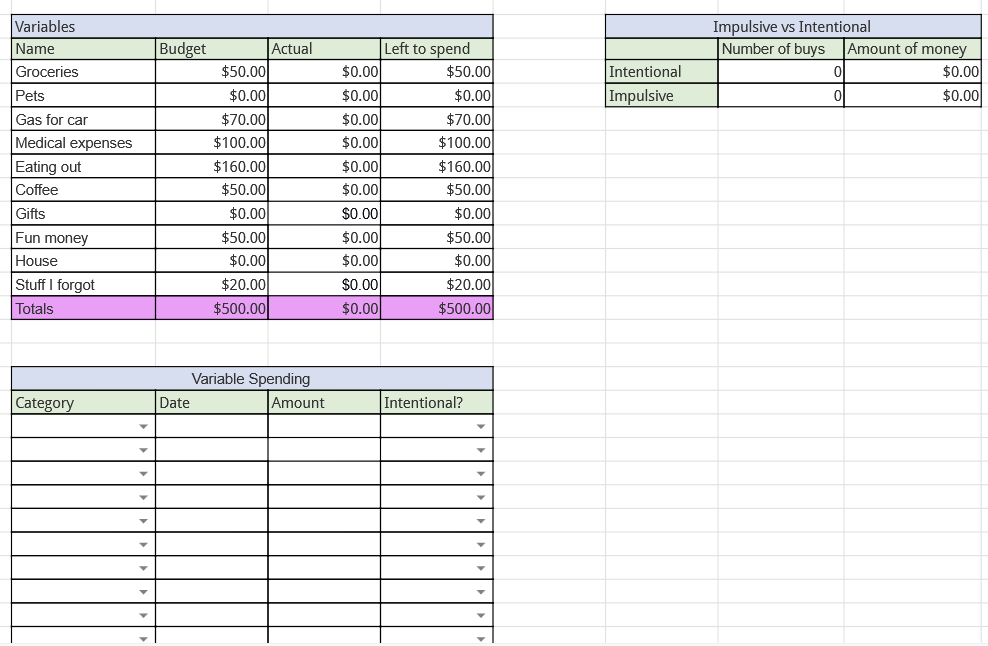
The last thing I do is fill out my variable expenses. There are some things that stay the same each month, and some that change. For example, my medical expenses are normally about $90 for medications and supplements, but if I have a doctor’s appointment, I’ll put more into that category. I really use my calendar and social plans to decide how much to put in each category. In September, my partner will have their birthday, so I’ll put money into the gift category. I almost always put $20 in “Stuff I forgot” in case something pops up, but I hardly use that category when tracking.
One thing to note is that my partner and I share 90% of groceries, which is put on our shared checking account. The fifty dollars shown in this table is for snacks I buy without the intention of sharing or farmers’ market purchases. Likewise, “Pets” is for my crested gecko, which is not really a shared pet. Anything for our two cats or our turtle will come out of our shared account.
It’s important to make your own categories based on what you spend the most on and what you want to keep track of. If you go out for happy hour drinks with friends or coworkers often, you could make a category for that. If you spend money on public transportation, there’s another category. Yes, I have a few categories with zero dollars in them, but these are all spending habits I want to keep my eye on.
The rest of this image shows where I track my variable expenses, which will come later.
There you have it. That’s everything I do to plan my spending. This is the easiest part.
Change Your Spending Mindset
This is the hardest part. In order to gain financial freedom, you need to change your mindset about spending. This has been hard for me, and is something I’m still working on.
Spending is not a reward.
I’m a huge fan of little treats. As I type this, I am wearing a shirt that says, “Please don’t bother me, I’m on my way to get a little treat.” Getting a reward after you accomplish a goal is nice. However, if you want financial freedom, spending money on a little treat should not be a daily or weekly occurrence.
I try my hardest not to use spending as a reward anymore. If I go for a run and think I deserve an iced matcha, I’ll make it at home. If I have a hard day and want to order food, I find something in my fridge that’s quick and easy.
Sometimes you may have a goal that involves spending. For example, I want to compete in a 5K, which costs money. Or, if I run a 5K, I want new running shoes so I can run longer distances. These are completely rational and fine, as long as your financial goals align with your personal goals. If you want to run a 5K, make sure you save the $50 race fee when you budget. This isn’t a reward, but a necessary expense to meet your goals.
Saving is not a sacrifice.
On the flip side, don’t treat saving with negative connotations. Sure, it may be lame to say no to a night of drinking with friends in order to save $40. What’s not lame? Meeting your financial goals and having the life you want.
An alternative response: when your friend asks if you want to go get a drink or go to a restaurant, if it’s not in your budget, ask if you can do a different activity that’s free or cheap. You could play board games, have drinks at home, go for a hike, or do a number of other activities.
I struggle with this part because I’m in my twenties. My twenties are the time to party, to live it up, and to have the life I want, right?
Not really. Your twenties probably won’t be the best time of your life, and that’s okay. Saving money instead of spending it will help you have a better life in your thirties and beyond.
Like I said, I prefer to think of spending as giving money to your future self. If I save enough money, I can spend it in the future on nicer things instead of settling for less.
Be careful spending on your work.
I’m guilty of spending money on snacks for my students, printed materials, outfits, and suits for work. While this is sometimes necessary, don’t let it catch you off guard. Think about what you really need and spend the bare minimum. At times, I bought something for work and later regretted spending so much money. Budgeting and sticking to your plan will help you ensure you don’t spend exorbitant amounts of money on your job.
Avoid lifestyle creep.
When you get a raise or get your first salary job, it’s easy to spend more money. Don’t do that carelessly.
Lifestyle creep is the concept that as you make more money, you will make bigger purchases and get nicer things, until suddenly you have an exorbitant lifestyle and you realize you’re still living paycheck-to-paycheck even though you make more.
Also known as living below your means, avoiding lifestyle creep means making smart decisions with your money. Before you buy a nice kitchen appliance because you got a raise, ask yourself what else you could do with that money.
My weakness is music. I have nice guitars and a small record collection. A Gibson Les Paul is my dream guitar, costing over $2,500. It would be easy to tell myself that once I make $60,000 a year, I can buy a Gibson Les Paul. What’s harder is doing the math and realizing I still won’t be able to afford it unless I put in the effort of saving.
The point of living below your means is to align your spending with your financial goals. If you have a job where you get free food, take advantage of that and save money on groceries. Live in a small apartment. You don’t need new clothes every month, and you don’t need to go out to eat every week. Deciding to live like this may not be easy for everyone, but a few months or years down the line, you’ll be happy you didn’t overspend.
Be intentional, not impulsive.
If there’s one thing you take from this post, I hope it’s this. I even have a tracking method for intentional versus impulsive spending on my budget spreadsheet.
Intentional spending involves planning, thoughtfulness, and won’t lead to regret.
Impulsive spending is usually unplanned and done without thinking about your budget.
This isn’t good versus bad spending, but it is important that the great majority of your spending is intentional. You can practice intentional spending by knowing how much you have available for your variable expenses and sticking to it.
I have a wishlist on my phone to keep track of what I want to spend money on. I try to wait at least a couple of weeks before buying anything I put on the wishlist. This helps me avoid overspending.
Track Your Spending
The last step of the monthly money-saving process is tracking what you actually spent. I do this every few days. I would recommend doing this at least weekly. The more you track your spending, the better grasp you will have of how much money you have left to spend.
You may notice that I changed some of my budgeting plans in the following screenshots. That’s because I decided on a savings goal after writing yesterday. That’s the nice thing about this spreadsheet – I’m able to edit my budget whenever I want to fit my goals.
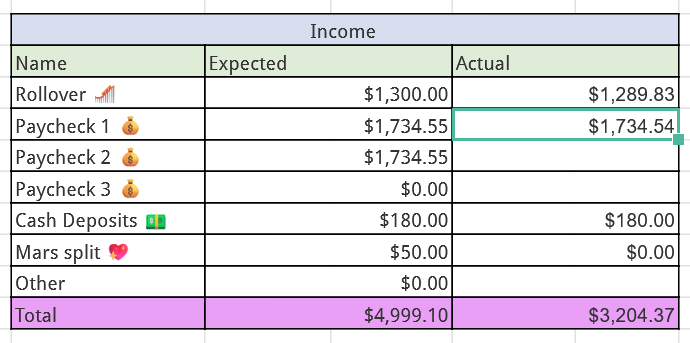
Before you spend, you need to get paid. My paychecks come on the 15th and the last day of the month. I use the latter paycheck for the following month, so I count it as Paycheck 1. I also already deposited cash from the last month at my part-time job.
Next, I type what I hope to have in my checking account when the month ends. I don’t put in any actual savings information until the end of the month, when I transfer the money to my savings account.
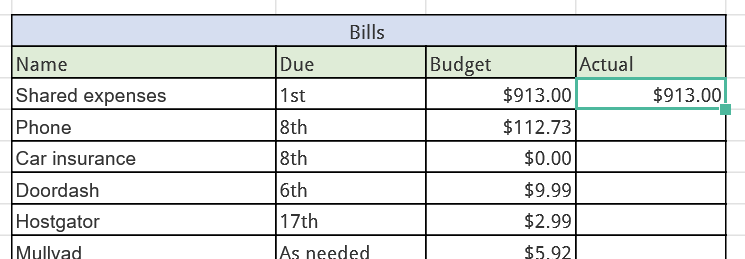
Filling out the bills section is the next step. I already transferred money from my personal checking account to my shared account, so I’ll put that in. I haven’t paid other bills yet, but when I do, I’ll fill out the “Actual” column.
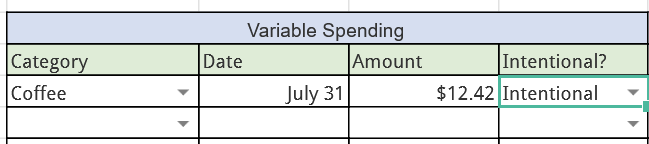
Here’s an example of what it will look like when I fill out my variable expenses. All of my variable transactions go in this table, and the other variable table automatically sums up what I’ve bought in each category. I count the last day of the month as belonging to the following month because I get paid that day. If that’s confusing for you, don’t do that.
In this example, I bought coffee today, the 31st, which cost $12.42 and was an intentional purchase. There is also an “impulsive” option. Which option I choose is purely based on vibes. This one is intentional because in this hypothetical example I planned to get coffee ahead of time and thought through my purchase.
Another note is that I don’t put transactions in here if they’re still pending in my checking account. There are many times that you might buy dinner or drinks, and the pending amount doesn’t include your tip. Gas is an example where the pending transaction could be more or less than what you actually spent.
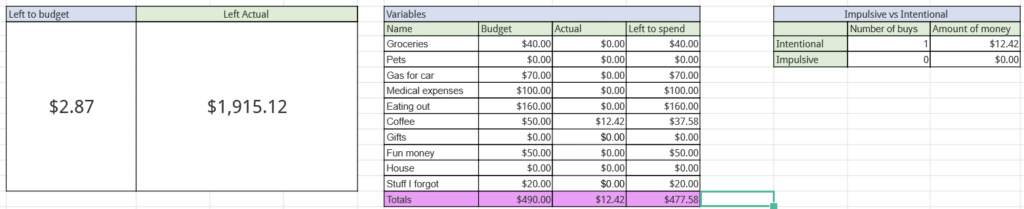
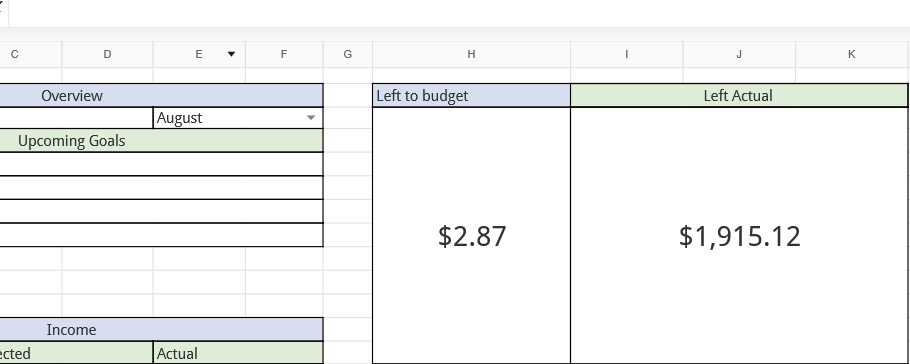
Lastly, I look at these three tables, but I don’t touch them. Everything that’s left will be auto-filled with formulas. The giant box is how much I have left in my budget after planning everything (I try to get to less than $5 to give almost every dollar a job), as well as the amount of money I actually have left – my paychecks minus my actual expenses. These just give me an idea of what I’m spending.
The “Variables” table shows me how much I’ve spent in each category and how much I have left to spend. Simple enough.
The third table shows how much I’m spending intentionally versus impulsively. This is a good way for me to take a glance and understand my moods when spending. If I’m spending hundreds of dollars impulsively, that’s a problem.
That’s everything! With these methods, I feel more in control of my money. It’s definitely hard to stay consistent with tracking and budgeting. That’s why I have my reason why and I make it into a habit. I’d love to answer any questions in the comments. If you like this spreadsheet and want your own blank version, let me know.